
Top Reliable Cash Flow Management Strategies for 2026: Best Practices by Business Type
The top reliable cash flow management strategies for 2026 are not theoretical frameworks you revisit once a year. They are operational disciplines you execute every billing cycle. 82% of small business failures trace directly back to cash flow mismanagement, and in 2026, with tighter credit conditions and longer client payment cycles, the margin for error is narrower than ever.
Try it on your next invoice
Draft from text or voice, edit every field, and export a PDF—free on the homepage.
Try AI invoiceKey Takeaways
| Strategy | Best For | Core Benefit |
|---|---|---|
| Rolling 13-Week Forecast | All business sizes | Closes cash flow gaps before they open |
| Automated Invoicing | Freelancers, SMBs, agencies | Eliminates billing delays and downstream errors |
| Clear Payment Terms | Service businesses | Anchors payment expectations on the document itself |
| AR Automation | High-volume operations | Cuts collection lag at scale |
| Zero-Based Budgeting | Cost-sensitive businesses | Forces expense justification every cycle |
| Cash Reserve Protocol | Businesses with seasonal revenue | Protects liquidity during slow periods |
| Multi-Client Receivables Tracking | Freelancers juggling multiple accounts | No invoice falls through the paper trail |
"Get them all right, and your invoice does the work for you."
Why Cash Flow Management Is the Foundation of Business Survival in 2026
Revenue is not cash. That distinction is where most small businesses lose the plot.
You can be profitable on paper and functionally insolvent by Tuesday if your receivables are aging and your payables are due. The top reliable cash flow management strategies for 2026 all address one root problem: the timing gap between money earned and money received.
In 2026, that gap has widened. Clients push Net 45 and Net 60 terms as standard. Supply chain costs are unpredictable. Credit lines are tighter. The businesses that survive are not the ones with the highest revenue. They are the ones who know, with precision, what lands in their account and when.
This is not optional.
Every strategy in this guide is tied to a concrete field, a specific process, or a measurable financial outcome. No motivational scaffolding. No abstract philosophy. Just the mechanics of staying solvent and getting paid.
Best for Forecasting: The Rolling 13-Week Cash Flow Projection
Annual budgets are not cash flow tools. They are planning documents. What you need for day-to-day survival is a rolling 13-week forecast.
Thirteen weeks is the operational sweet spot. It is long enough to see a cash flow gap forming. It is short enough that your numbers stay accurate and actionable.
Here is what a 13-week forecast tracks, week by week:
- Opening cash balance — what you start each week with
- Expected inflows — confirmed invoices, recurring retainers, known client payments
- Expected outflows — payroll, rent, vendor payments, subscriptions
- Net weekly position — the real number, not the projected one
- Cumulative closing balance — your early warning system
The forecast only works if you update it every week. Not monthly. Not quarterly. Weekly.
A gap visible at week eight gives you five weeks to act. A gap visible at week one gives you five days to panic. Two dates, two distinct outcomes.
The anchor for the inflow side of this forecast is your invoice data. Every outstanding invoice is a future cash position. If your invoices are incomplete, late, or missing payment terms, your forecast is fiction.
Best for Closing the Cash Flow Gap: Smarter Invoice Workflows
The single largest controllable driver of cash flow gaps is invoice timing and accuracy. Most businesses lose days, sometimes weeks, simply because their billing process is manual, inconsistent, or error-prone.
Knowing how to create an invoice correctly is one of the most practical skills any freelancer, small business owner, or growing team can have. Every invoice you send is either accelerating your cash position or delaying it.
The fields that matter most are not complicated. They are just non-negotiable:
- Invoice number — your sequential identifier and the anchor for every downstream process
- Issue date and due date — two dates, two distinct jobs; one establishes the document, one triggers payment
- Itemized line items — no ambiguity, no missing details
- Payment terms — Net 30, Net 15, or due on receipt stated explicitly on the document
- Total amount due — verified, not estimated
Without a hard deadline on the document, "Net 30" lives only in your head, not theirs.
Miss any of these, and you risk delayed payments or client confusion. Get them all right, and your invoice does the work for you.
Our AI invoice generator handle the heavy lifting on the drafting side. You type or speak a description of the work, the AI fills in the structured fields, and you land on a complete, formatted PDF in seconds. That is the downstream process working correctly from the start.
Did You Know?
91% of mid-sized businesses that adopted automated accounts receivable (AR) systems reported a significant improvement in cash flow.
Source: DocuClipper 2026
Best for Reducing Late Payments: Payment Terms That Live on the Document
Late payments are not always a client problem. Often, they are a documentation problem.
If your invoice does not state a due date, a late fee policy, and a preferred payment method, you have given the client no firm contract to honor. The terms exist in your memory, not in theirs. That is not a rounding error. That is a structural flaw in your billing process.
Here is the payment terms framework that consistently reduces days sales outstanding (DSO) in 2026:
- State the payment term explicitly: "Payment due within 14 days of invoice date" beats "Net 14" for clients unfamiliar with the shorthand.
- Add a late fee clause: "A 1.5% monthly fee applies to balances unpaid after 14 days." It does not need to be punitive. It needs to exist.
- List accepted payment methods: ACH, credit card, bank transfer. Remove friction from the payment path.
- Use due on receipt for small jobs: For projects under a defined threshold, due on receipt is the cleanest term. No ambiguity, no negotiation window.
- Send a reminder at day seven: Automated reminders sent before the due date, not after, cut late payments significantly.
Your invoice number is the anchor for every downstream process: your accounting records, the client's purchase order match, tax filing, and dispute resolution. The payment terms on that invoice are what give that anchor its authority.
For professional service businesses, the professional services invoice templates include pre-structured fields for payment terms, late fee language, and client details, so nothing gets omitted in a rush.
Best for High-Volume Operations: Automating Accounts Receivable in 2026
Manual AR is a volume problem disguised as a process problem. When you are sending 20 invoices a month, a manual workflow is painful but survivable. When you are sending 200, it becomes a cash flow liability.
Automation in 2026 does not mean removing human judgment from the process. AI-driven invoicing doesn't mean hands-off invoicing. It means the heavy lifting is automated, and the judgment stays with you.
The specific automation points that move the needle on receivables:
- Bulk invoice generation: Upload a CSV with client data, job details, and amounts. Generate hundreds of invoices in a single batch. The bulk invoice generator handles this without manual data re-entry for every line.
- OCR Scan for incoming documents: Use invoice OCR processing to extract data from paper or scanned invoices automatically, feeding your AR records without manual transcription.
- Automated payment reminders: Schedule reminders at seven days before due, on the due date, and at three days past due. This alone reduces average collection time by double-digit percentages.
- Recurring invoice setup: For retainer clients or subscription-based work, automated recurring invoices remove the risk of a billing cycle being missed entirely.
The verification step still belongs to you. Always review totals and terms before downloading; this isn't a caveat, it's a workflow step. Automation handles the data assembly. You confirm the output is accurate before it reaches the client.
Best for Multi-Client Businesses: Structured Receivables Tracking
Freelancers and agencies juggling multiple clients face a specific cash flow risk: invoice dispersion. Money is owed from six different directions, on six different timelines, with six different payment behaviors.
Without structure, that is not a cash flow. That is a guessing game.
A multi-client receivables dashboard solves this. The goal is a single view that shows, for every active client:
- Total invoiced this period
- Amount received
- Amount outstanding
- Days outstanding on each unpaid invoice
- Next follow-up date
This is the paper trail that protects you when a client disputes an invoice or claims they never received it. You need the sequential identifier, the send date, and the delivery confirmation. All of it lives in the same workspace.
The multi-client invoicing workspace gives freelancers and small agencies exactly this view. Every client account is compartmentalized, every invoice is traceable, and the outstanding balance is visible at a glance without switching between spreadsheets.
For businesses operating across multiple industries simultaneously, industry-specific templates reinforce billing accuracy by industry. A construction and trades invoice template captures labor, materials, and project milestones in a format contractors and their clients recognize. A transportation and logistics template handles DOT-compliant details without manual formatting.
No ambiguity, no missing details. Each client billed in the format appropriate to their industry.
Did You Know?
91% of mid-sized businesses that adopted automated accounts receivable (AR) systems reported a significant improvement in cash flow, making AR automation the single highest-impact operational change available in 2026.
Source: DocuClipper 2026
Best for Tightening Expense Control: Zero-Based Budgeting by Quarter
Cash flow management is not only about accelerating inflows. Controlling outflows with the same precision is equally critical, and zero-based budgeting (ZBB) is the most disciplined framework available for doing that in 2026.
ZBB starts every budget period at zero. Every expense must be justified from scratch. No line item carries over by default.
This is not a time-consuming overhaul if you approach it at the right cadence. Applied quarterly, ZBB forces you to answer three questions about every cost:
- Is this expense still generating a return? Subscriptions, tools, and vendor contracts that made sense six months ago may not justify renewal today.
- Is this expense at the right level? Over-provisioned software plans, unused seats, and redundant services create silent cash flow drag that compounds quarterly.
- Is there a better-priced alternative that delivers the same output? In 2026, the answer to this question is more often "yes" than it was two years ago.
ZBB does not require sophisticated software. It requires discipline and a structured line-item review. The output is a leaner cost base that widens your operating cash position without touching revenue at all.
For businesses running invoicing at scale, the same logic applies to plan selection. A Professional plan at $14.99/month covers 50 cloud saves per day with full dashboard access. A Business plan at $29.99/month unlocks unlimited AI and OCR processing with API exports. The right tier depends on actual volume, not projected volume. That is not a rounding error; it is a decision that compounds over twelve months.
Best for Protecting Liquidity: Building a Cash Reserve Protocol
A cash reserve is not savings. It is operational infrastructure.
The protocol is straightforward: define a target reserve equal to 8 to 12 weeks of fixed operating expenses, and treat it as untouchable except for specific, pre-defined scenarios (payroll shortfall, unexpected client non-payment on a large invoice, equipment failure).
Building that reserve requires a contribution rule. A percentage of every received payment, not every invoiced payment, flows into the reserve account automatically. The percentage depends on your margin, but 5% to 10% of gross receipts is a practical starting point for most service businesses.
The reserve is not an emergency fund built from leftover money at month end. It is a first-priority allocation built from systematic discipline. The distinction matters because leftover money rarely exists. Systematic allocation always does.
Seasonal businesses (events, hospitality, childcare, automotive services) carry a higher reserve obligation. Their revenue clusters in predictable windows. Their expenses do not. For event and hospitality operators, events and hospitality invoice templates that capture deposits, staged payments, and final balances help structure the inflow side of this protection correctly.
Top Reliable Cash Flow Management Strategies for 2026: Best Practices by Industry
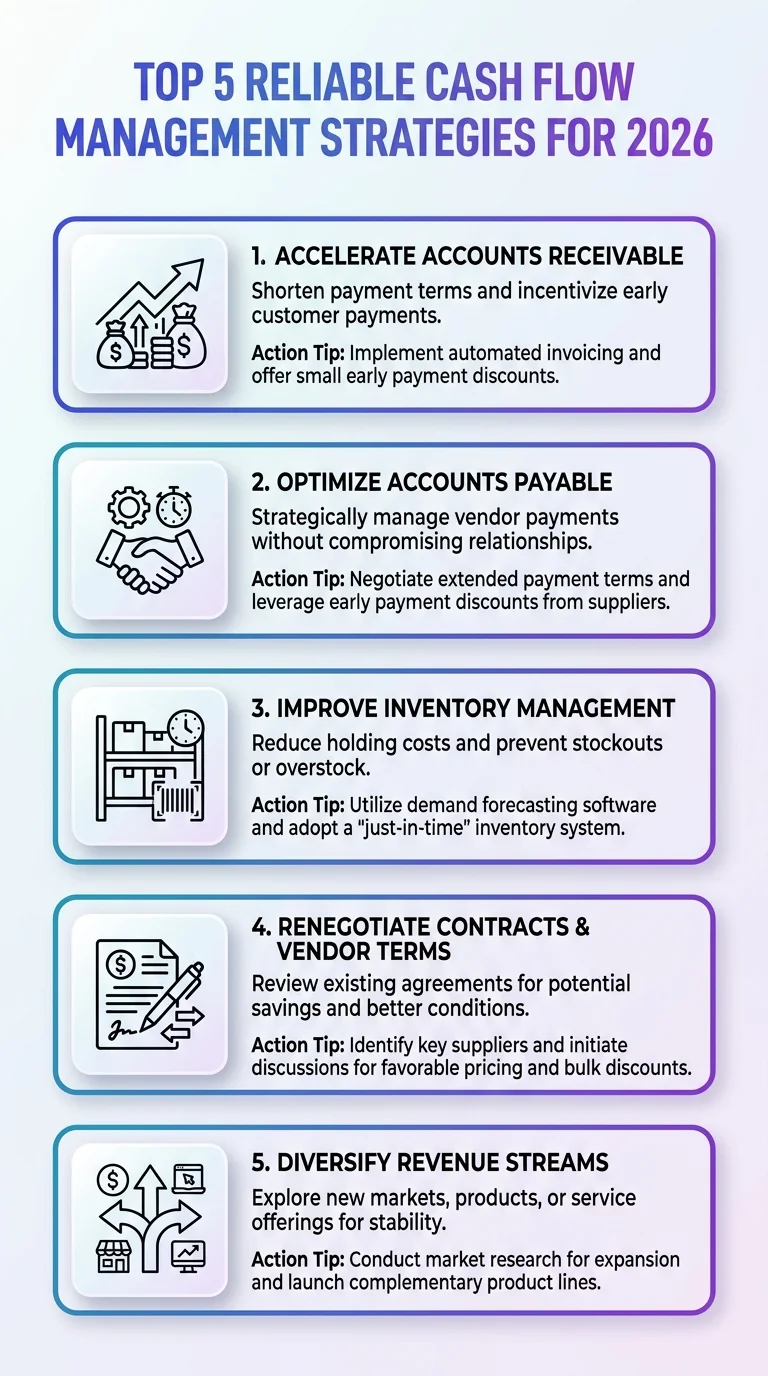
An at-a-glance visual of the top five cash flow management strategies for 2026. It highlights practical steps to improve liquidity and forecast accuracy.
Different industries carry different cash flow risk profiles. The strategies are the same. The application varies.
| Industry | Primary Cash Flow Risk | Priority Strategy |
|---|---|---|
| Construction and Trades | Long project timelines, milestone billing disputes | Detailed line items, milestone-triggered invoicing |
| Property Management | Tenant payment inconsistency, late fee enforcement | Recurring invoices, automated reminders, late fee clauses |
| Transportation and Logistics | Fuel cost volatility, freight payment delays | 13-week forecast, ZBB for fuel and maintenance |
| Professional Services | Client scope creep, payment term negotiations | Clear payment terms on every invoice, due on receipt for small engagements |
| Childcare and Education | Enrollment fluctuation, irregular family payment patterns | Recurring monthly invoices, cash reserve protocol |
| Automotive Services | Parts cost volatility, insurance payment delays | Accurate parts and labor line items, deposit invoicing |
The throughline across every industry is the same: the invoice is the anchor. If the billing document is inaccurate, incomplete, or late, every downstream process, your accounting, your forecast, your reserve contributions, degrades from that point forward.
For businesses managing mixed-industry client portfolios, the full invoice template library covers 20-plus industry starting points, each with the specific fields and layouts that reduce billing friction in that vertical.
Best for Scaling: The AI-Assisted Billing Loop in 2026
The fastest-growing businesses in 2026 are not the ones with the largest teams. They are the ones with the tightest operational loops. And nowhere is a tight loop more valuable than in the billing cycle.
The AI-assisted billing loop works like this:
- Draft: AI generates the invoice from a text or voice prompt, populating client details, line items, dates, and payment terms automatically.
- Verify: You review every field. Check the totals. Verify the client details. Confirm the sequential identifier is correct. This is the verification step, and it is not optional.
- Send: Export the PDF and deliver it through your preferred channel, email, WhatsApp, or a shareable link.
- Track: The invoice is logged to your dashboard, your receivables view updates, and your 13-week forecast pulls from live data.
- Follow up: Automated reminders trigger based on the due date. No manual calendar entries required.
This loop, executed consistently, is what eliminates the cash flow gap created by billing delays. AI-driven invoicing doesn't mean hands-off invoicing. It means the heavy lifting is automated, and the judgment stays with you.
For high-volume operations using the best AI-driven invoicing and billing automation strategies, the Pro Bulk CSV feature compresses hundreds of invoices into a single generation event. The OCR Scan extracts data from existing documents directly into the workflow. Both capabilities reduce the time between work completed and invoice sent to near zero.
Conclusion: Top Reliable Cash Flow Management Strategies for 2026 Start With the Invoice
Every strategy in this guide, forecasting, AR automation, ZBB, reserve building, payment term discipline, connects back to one operational foundation: the accuracy and timeliness of your invoicing.
The top reliable cash flow management strategies for 2026 are not independent levers you pull one at a time. They are interconnected. A rolling 13-week forecast is only as accurate as your receivables data. Your receivables data is only as reliable as the invoices that created it. And those invoices are only as strong as the fields, terms, and sequential identifiers they contain.
That is not a rounding error. That is the entire system.
Get the invoice right, and every downstream process runs correctly. Miss the invoice, and every strategy in this article loses its foundation. The paper trail either protects you or it does not. In 2026, there is no middle ground.
Start with a free eInvoice account to build that foundation today. No ambiguity, no missing details, no cash flow gap you did not see coming.
Frequently Asked Questions
What are the most reliable cash flow management strategies for small businesses in 2026?
The most reliable cash flow management strategies for 2026 are rolling 13-week forecasting, automated accounts receivable, clear payment terms on every invoice, and a systematic cash reserve protocol. These four strategies address both the timing and the accuracy problems that cause most small business cash flow gaps.
How does invoicing directly impact cash flow management?
Every invoice you send is a future cash position. Invoices with missing payment terms, inaccurate totals, or no due date extend your collection timeline and distort your forecast. Accurate, timely invoicing is the single most controllable input in any cash flow management strategy.
Is automated invoicing actually worth it for managing cash flow in 2026?
Yes, and the data is clear. 91% of mid-sized businesses that adopted automated AR systems reported a significant improvement in cash flow. For small businesses and freelancers, AI-assisted invoicing reduces the time between work delivered and invoice sent, which directly closes the cash flow gap.
What payment terms should I use to improve cash flow in 2026?
For most service businesses, Net 14 with an explicit late fee clause outperforms Net 30 on average collection time. For small, one-off jobs, "due on receipt" is the cleanest term available. The key rule: whatever term you choose must appear on the document itself, not just in a verbal agreement.
How much cash reserve should a small business hold in 2026?
A reserve equal to 8 to 12 weeks of fixed operating expenses is the standard benchmark for service businesses in 2026. Seasonal businesses (events, hospitality, childcare) should target the higher end of that range given their revenue concentration windows.
What is a rolling 13-week cash flow forecast and how do I build one?
A rolling 13-week forecast tracks your weekly opening balance, expected inflows from outstanding invoices, and confirmed outflows, producing a net weekly position and a cumulative closing balance for each of the next 91 days. It updates every week, meaning the forecast always looks 13 weeks forward from your current date, giving you an early warning system for cash flow gaps before they become crises.
How do I close a cash flow gap quickly without taking on debt?
The fastest non-debt options are accelerating invoicing (send invoices the day work is completed, not the day after), offering a small early payment discount (2% off for payment within 7 days), and auditing your immediate expenses using ZBB logic to find costs that can be paused. All three are executable within one billing cycle.
Ready to create your next invoice?
Use AI drafting on the homepage or sign up for a free account with cloud save and monthly plan limits.
Related articles
We'are Listed on
How to Invoice as a Freelance Writer: What to Include and How to Bill for Writing Projects
Discover essential tips on invoicing as a freelance writer. Learn what to include and how to effectively bill for your writing projects.
How to Send an Invoice Email (2026 Best Practices for Getting Paid Faster)
Learn how to send effective invoice emails in 2026. Improve deliverability, automate reminders, and enhance your billing process for quicker payments.
Can AI check an invoice before sending? Can it detect missing fields, duplicates, incorrect totals, unusual amounts?
Discover how AI can enhance your invoicing process by detecting errors, duplicates, and unusual amounts before sending. Streamline your billing cycle today.