
Ultimate Guide to Freelance Tax Deductions and Invoicing
The ultimate guide to freelance tax deductions and invoicing starts with one uncomfortable number: 85% of freelancers experience late payments, with 21% being paid late more than half the time. That is not a rounding error. It's a structural problem in how most freelancers bill, track, and document their income — and it has direct consequences at tax time.
Try it on your next invoice
Draft from text or voice, edit every field, and export a PDF—free on the homepage.
Try AI invoiceKey Takeaways
| Question | Answer |
|---|---|
| What deductions can freelancers claim in 2026? | Home office, equipment, software, internet, professional development, travel, and health insurance premiums are among the most common. |
| Why does proper invoicing matter for tax filing? | Every invoice is a tax record. Accurate, timestamped invoices prove income, substantiate deductions, and reduce audit risk. |
| How should freelancers track deductible expenses? | Separate business and personal accounts, retain all receipts, and log expenses immediately rather than reconstructing them quarterly. |
| What's the difference between an invoice and a receipt for tax purposes? | An invoice requests payment before it's made; a receipt confirms payment after. You need both in your records. Learn the full invoice vs. receipt breakdown to keep your records clean. |
| Can AI help freelancers invoice more accurately? | Yes. AI-driven invoicing tools reduce the biological error floor that manual entry carries, which directly improves tax documentation accuracy. |
| How often should freelancers invoice clients? | Immediately upon project completion or on a fixed schedule (weekly, bi-weekly, or monthly). Delayed invoicing delays the entire cash flow cycle. |
| What invoice template fields protect you at tax time? | Invoice number, date issued, itemized services, client details, payment terms, and tax amounts. Get them all right, and your invoice does the work for you. |
What the Ultimate Guide to Freelance Tax Deductions Actually Covers
Most freelancers underestimate what's deductible. Then they overpay. Then they wonder why their margin looks wrong every April.
The IRS doesn't care about your good intentions. It cares about documentation. If you can't prove an expense was ordinary and necessary for your freelance business, you don't get the deduction.
Here's what's actually on the table in 2026:
- Home Office Deduction: If you use a dedicated space exclusively for work, you can deduct a percentage of rent or mortgage interest, utilities, and internet costs based on square footage.
- Equipment and Hardware: Laptops, monitors, cameras, microphones, external drives. Business use must exceed 50% to qualify for Section 179 expensing.
- Software Subscriptions: Design tools, invoicing platforms, project management apps, cloud storage. All deductible if used for business.
- Internet and Phone: Deduct the business-use percentage. If you use your phone 70% for work, 70% of the bill is deductible.
- Professional Development: Courses, certifications, books, and conferences directly related to your freelance field.
- Health Insurance Premiums: If you're self-employed and not eligible for employer coverage, premiums for yourself and your family are deductible above the line.
- Self-Employment Tax Deduction: You pay both sides of FICA. The IRS lets you deduct half of that from your gross income.
- Retirement Contributions: SEP-IRA, SIMPLE IRA, and Solo 401(k) contributions reduce your taxable income dollar for dollar.
That's a significant list. Missing any of it is bleeding overhead in a completely avoidable way.
Why Your Invoicing System Is the Foundation of Freelance Tax Deductions
This part gets skipped in most freelance tax guides. It shouldn't.
Your invoices aren't just billing documents. They're your income ledger. Every invoice you send creates a timestamped record of what you earned, from whom, and for what service. That record is what the IRS uses to verify your gross income. It's also what your accountant uses to calculate your deduction eligibility against total revenue.
Sloppy invoicing creates sloppy tax records. Sloppy tax records create audit risk.
The fix is structural. You need a consistent invoicing process with a numbered system, standard payment terms, and itemized line items on every single document. Manual form filling isn't a minor inconvenience. It's an active liability. Manual form filling carries a biological error floor of 1-4% per entry, and even a single transposed number on a client invoice can create a discrepancy that requires hours to trace.
Start with solid templates. The customizable invoice templates available for freelancers give you a structured starting point with all the fields that matter for both billing and tax documentation.
Did You Know?
Trust in AI for tax filing dropped to 37% in 2026, down from 43% the previous year — meaning more freelancers are relying on accurate paper trails and documentation than ever before.
Source: Journal of Accountancy, Invoice Home U.S. Tax Filing Report 2026
How to Create an Invoice That Protects Your Freelance Tax Position
A compliant, tax-ready invoice has specific fields. Not optional fields. Required ones.
Here's the complete list:
- Unique Invoice Number: Sequential numbering lets you audit your own income records at year-end without reconstructing anything from memory.
- Invoice Date and Due Date: These establish when income was earned (accrual basis) or when payment was received (cash basis). Your tax method determines which matters more.
- Your Full Business Name and Address: Even as a sole proprietor, your legal name and business address must appear.
- Client Name and Address: For any client paying you more than $600 in a tax year, this is the information that gets matched against their 1099-NEC filing.
- Itemized Service Descriptions: Line-by-line. "Design work" is not sufficient. "Brand identity design - logo, color palette, and typography system" is.
- Rates and Quantities: Hourly, project-based, or retainer. State the rate and the unit clearly.
- Subtotal, Tax Line (if applicable), and Total Due: If you collect sales tax on any services in your jurisdiction, it must appear as a separate line item.
- Payment Terms: Net 30, Net 15, due on receipt. State it explicitly. This is what triggers your follow-up workflow when payment is late.
Get them all right, and your invoice does the work for you. Miss one, and you're correcting records manually during the worst possible time of year.
The step-by-step process for creating an invoice correctly covers each field in detail, including common formatting mistakes that create reconciliation problems later.
The Cash Flow Cycle: Why Ultimate Freelance Tax Deductions Depend on Getting Paid
You can't deduct your way out of a cash flow problem. But you can invoice your way into a better tax position.
Here's the connection most freelancers miss: deductions reduce your taxable income. But your taxable income is your gross revenue minus allowable deductions. If late payments are pushing revenue into the wrong tax year, you're either reporting income before you've received it or scrambling to track payments across two fiscal years.
Tighten the cash flow cycle and the tax math gets simpler.
The three fastest ways to close the gap between invoicing and payment:
- Send invoices immediately. Not at the end of the week. The moment a deliverable is submitted or a milestone is hit.
- Use short payment terms. Net 30 is the default, but Net 14 or Net 7 is achievable with most clients if you build it into your contract from the start.
- Follow up systematically. A reminder three days before due date, on the due date, and three days after is not aggressive. It's professional.
This isn't a caveat. It's a workflow step. Build it in every time.
Tracking Deductible Expenses: The System That Works Under Pressure
Freelancers under pressure make the same mistake: they batch their expense tracking quarterly. Then they can't reconstruct three months of purchases accurately. Then they under-claim deductions. Then they overpay.
The correct system is real-time logging. Every expense, the day it happens.
You need three things:
- A dedicated business bank account and credit card. Zero personal purchases on the business card. This creates a clean transaction record that maps directly to your deduction categories.
- A receipt capture process. Every physical receipt photographed immediately. Every digital receipt filed in a labeled folder the same day it arrives.
- A category system that mirrors IRS Schedule C. Office expenses, advertising, contract labor, utilities, travel. Use the same categories the IRS uses so there's no translation layer at filing time.
The goal is zero reconstruction at year-end. Everything should already be logged, categorized, and ready to hand to your accountant or import into your tax software.
AI-Driven Invoicing and the Ultimate Guide to Freelance Tax Deductions in 2026
Think about it this way: a business processing 500 invoices per month manually is burning time on every single field. Even at one invoice per week, manual entry introduces errors that compound into tax record problems.
AI-driven invoicing in 2026 changes this calculus. Manual invoice processing costs between $12.88 and $19.83 per invoice, while AI-automated systems drop this cost to under $1. That gap is not theoretical. If you're still running manual invoicing workflows, that gap is coming directly out of your margin.
The practical difference shows up in three areas:
- Field accuracy. Smart Fill technology populates invoice fields from plain English input. You type or speak your project details and the tool maps them to the correct fields automatically. No templates to configure from scratch. No fields to hunt down. Just plain English input and a professional PDF output.
- Speed under deadline. When you're finalizing a project late on a Friday, friction is the enemy. Zero-login access means no account creation wall between you and a sent invoice. Account creation is friction. Eliminating it matters.
- Live preview before export. A live preview catches layout and data errors before the invoice reaches a client. Catching errors at the preview stage costs nothing. Catching them after a client has already filed the invoice against a purchase order costs significant administrative time on both sides.
Switching to AI-driven invoicing isn't just about one feature. It's the entire feature set working together.
Did You Know?
85% of freelancers experience late payments, with 21% being paid late more than half the time — making systematic invoicing follow-ups a non-negotiable part of any freelance cash flow strategy.
Source: Remote State of Freelance Work 2025
Common Freelance Invoicing Mistakes That Destroy Tax Deductions
These aren't edge cases. These are patterns that repeat across thousands of freelance returns every year.
- No invoice numbering system. Without sequential numbers, you can't prove you've accounted for every job. An auditor will notice gaps.
- Vague service descriptions. "Consulting" on an invoice tells the IRS nothing. Itemized descriptions prove the nature of the work and support your deduction claims for related expenses.
- Missing payment date records. Sending an invoice is not the same as receiving payment. You need documented confirmation of when funds actually cleared, especially if you're on a cash basis.
- Mixing personal and business expenses on invoices or receipts. If a client reimbursed you for travel and you included a personal expense in that total, you now have a reconciliation problem that touches both your income and your deduction records.
- No follow-up documentation for disputed invoices. If a client disputes an amount and you settle for less, that difference is potentially a bad debt deduction. But only if you documented the original invoice, the dispute, and the resolution.
- Failing to send invoices at all for informal clients. Cash or PayPal payments from friends-of-friends still count as taxable income. No invoice means no paper trail means no protection if those payments are ever questioned.
The best practices for sending invoices cover delivery timing, format choices, and follow-up protocols that prevent most of these errors before they happen.
Multi-Client Invoicing and Bulk Deduction Documentation
If you're managing more than five clients at once, single-invoice workflows start to break down. The problem isn't capability. It's volume and consistency. Every client tab that runs through a different process produces a slightly different document format, which creates inconsistency in your records at year-end.
The solution is a system where each client tab acts as an independent invoice, exportable as a single ZIP at the end of a billing cycle. Bulk conversion from a CSV with column mapping eliminates the risk that you'll format one client's invoice differently than another's.
Consistency in invoice format isn't just an aesthetic preference. It's a record-keeping discipline. Uniform documents are easier to audit, easier to reconcile, and easier to hand off to a tax professional without explanation.
The complete invoicing guide for freelancers and small businesses walks through all four major invoicing methods, from single-invoice creation to bulk workflows, with practical guidance on choosing the right approach based on your client volume.
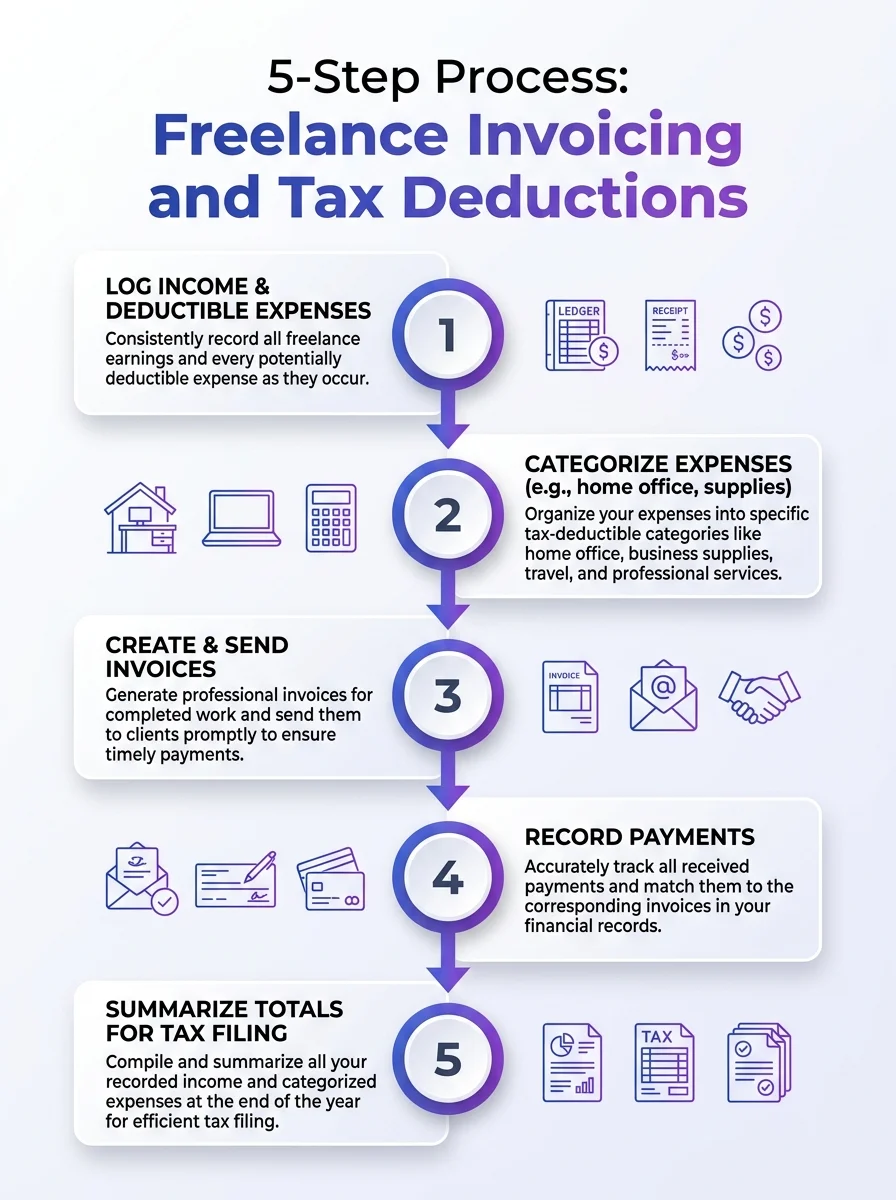 A visual roadmap of a 5-step process for freelance invoicing and tax deductions. It helps freelancers maximize deductions while staying compliant.
Quarterly Estimated Taxes and Your Invoicing Calendar
This is where most freelancers experience their worst tax surprises. W-2 employees have withholding. You don't. Every dollar you earn lands in your account without a deduction, which means you're responsible for setting aside and remitting your own tax liability four times per year.
In 2026, the IRS quarterly estimated tax deadlines fall in April, June, September, and January. Miss them and you pay an underpayment penalty on top of your tax bill.
Your invoicing calendar is your best tool for managing this. Here's the framework:
- Calculate your estimated tax rate. Self-employment tax (15.3% on net earnings) plus your income tax bracket. Most freelancers set aside 25-30% of every payment received.
- Reconcile your invoices at the end of each month. Every paid invoice is income. Every paid invoice triggers a transfer to your tax savings account.
- Tally deductible expenses quarterly. Before each estimated payment, calculate your current deductions to reduce the taxable base you're paying against.
- Adjust your estimates as income changes. A big project completion in Q2 means a larger Q3 estimated payment. Invoice tracking makes this visible in real time rather than as a surprise in January.
The invoicing system you use directly determines how well you can execute this process. Disorganized invoices mean disorganized income tracking, which means inaccurate quarterly estimates, which means either overpaying or getting hit with penalties.
Home Office Deduction: The Invoicing Connection
The home office deduction is one of the highest-value deductions available to freelancers. It's also one of the most frequently miscalculated.
You have two methods: the simplified method ($5 per square foot, up to 300 square feet, maximum $1,500 deduction) or the regular method (actual expenses multiplied by the business-use percentage of your home).
The regular method almost always produces a larger deduction. But it requires documentation of your actual home expenses for the year, including rent or mortgage interest, utilities, renters or homeowners insurance, and repairs attributable to the workspace.
Your invoices connect to this indirectly. If you're claiming a home office, the IRS expects your business to be genuine and active. A consistent invoice record with regular billing activity across the tax year substantiates that your home office is, in fact, a place where real business happens.
Sparse or irregular invoicing raises questions. Consistent, professional invoicing answers them before they're asked.
The Ultimate Guide to Freelance Tax Deductions and Invoicing Comes Down to Systems
The ultimate guide to freelance tax deductions and invoicing isn't about knowing every obscure tax code. It's about building systems that produce accurate, consistent documentation automatically.
Invoicing is tax preparation. Every invoice you send is a record that either protects or exposes your financial position when April arrives. Get the invoicing system right and the tax deduction process becomes significantly more manageable.
The practical steps are straightforward:
- Invoice immediately, using a numbered system with itemized line items
- Track expenses in real time, categorized to match IRS Schedule C
- Set aside estimated tax payments against every paid invoice
- Follow up on late payments systematically, not reactively
- Use AI-driven tools to eliminate the error floor that manual entry introduces
- Keep both invoices and receipts, understanding the documentation role each one plays
If you're still running manual invoicing workflows, that gap is coming directly out of your margin. The freelance tax deductions you're entitled to are substantial. The invoicing infrastructure to support them doesn't need to be complicated. It just needs to be consistent.
Start with the step-by-step invoice creation guide and build from there.
Frequently Asked Questions
What are the most overlooked freelance tax deductions in 2026?
The self-employment tax deduction (50% of your SE tax), retirement contributions to a Solo 401(k) or SEP-IRA, and professional development expenses are consistently underused. Health insurance premiums are also frequently missed by freelancers who pay out of pocket. This ultimate guide to freelance tax deductions covers all of them as trackable, documentable line items.
How does invoicing software help with freelance tax deductions?
Invoicing software creates a timestamped income record that your accountant uses to calculate your gross revenue and deduction eligibility. AI-driven platforms with Smart Fill technology reduce entry errors that can cause income mismatches on your tax return. Accurate invoices equal accurate tax filing.
Is a freelance invoice legally required for tax purposes?
The IRS doesn't mandate invoices by name, but it does require documentation of income and business transactions. A properly formatted invoice is the most reliable form of that documentation for freelancers billing clients on a project or retainer basis. Missing invoices create gaps that are difficult to explain in an audit.
What should a freelance invoice include to support tax deductions?
At minimum: a unique invoice number, invoice date, your legal name and address, the client's name and address, itemized service descriptions with rates, payment terms, and the total amount due. For freelance tax deduction purposes, the service descriptions matter most because they connect your billable work to your deductible business expenses.
How do I handle late-paying clients and taxes on unpaid invoices?
If you're on a cash basis (most freelancers are), you only owe tax on income actually received. Unpaid invoices don't create a tax liability until payment clears. However, you still need to track open invoices carefully, because once payment arrives, it triggers a tax obligation regardless of which quarter it lands in.
Is it worth paying for invoicing software as a freelancer in 2026?
Yes. The cost of professional invoicing software is itself a deductible business expense, and the reduction in billing errors pays for the subscription multiple times over. Manual invoice processing costs between $12.88 and $19.83 per invoice. AI-automated systems bring that cost under $1. The math on the ultimate guide to freelance tax deductions and invoicing strongly favors automation.
How many years of invoices should a freelancer keep for tax purposes?
The IRS generally recommends keeping records for at least three years from the date you filed your return, or two years from the date you paid the tax, whichever is later. If you've underreported income by more than 25%, that window extends to six years. Keep everything digital, backed up, and organized by tax year.
Ready to create your next invoice?
Use AI drafting on the homepage or sign up for a free account with cloud save and monthly plan limits.
Related articles
We'are Listed on
How to Invoice as a Freelance Writer: What to Include and How to Bill for Writing Projects
Discover essential tips on invoicing as a freelance writer. Learn what to include and how to effectively bill for your writing projects.
How to Send an Invoice Email (2026 Best Practices for Getting Paid Faster)
Learn how to send effective invoice emails in 2026. Improve deliverability, automate reminders, and enhance your billing process for quicker payments.
Can AI check an invoice before sending? Can it detect missing fields, duplicates, incorrect totals, unusual amounts?
Discover how AI can enhance your invoicing process by detecting errors, duplicates, and unusual amounts before sending. Streamline your billing cycle today.